In preparation for cooking the feast, an exploration as to the history of the menu was done. I hope you enjoy!
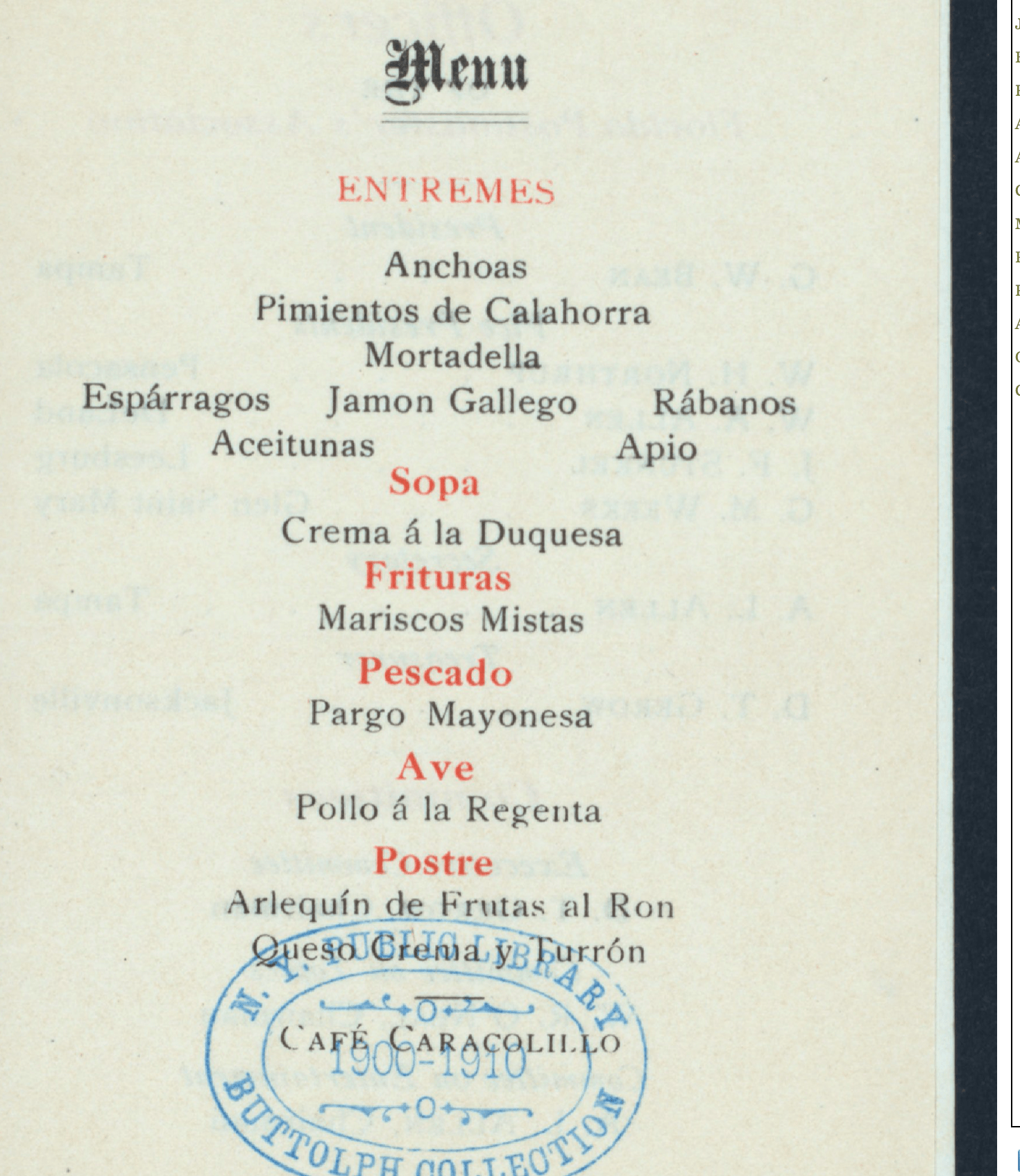
The Grand Orient Restaurant Garcia’s Place was a popular site for banquets and daily eating in the historic Ybor, Florida. The restaurant, located at the corner of 7th Avenue and 16th Street, in an area that was close to the city’s post office, drug stores, other food services, and retail stores. While the restaurant changed ownership a few times, its Spanish roots stayed intact, as was reflected by the staff and the culinary standard choices. I have found that, out of the sixteen banquet menus listen by this restaurant in archives, the majority of every menu was the same between the years of 1905 and 1908. Seasonal dishes and appetizers appeared on the menu at different times of year, and were occasionally swapped out, but the main courses and desserts remained constant. Dishes most often repeated for banquet menus included Galician ham, mortadella, anchovies, radishes, and asparagus. The dessert options did not change in any of the menus. The dishes that were repeated the most throughout the banquet menus happen to be of Spanish origin, in homage to the ownership and staff’s background. Additionally, all of the menu options are in Spanish, further adding to the aesthetic.
The set menu from the Postmaster’s Association banquet was comprised of the following[1]. For starters, anchovies, Calahorra peppers, mortadella, Galician ham, asparagus, radishes, olives, and celery, and Duchess cream soup were listed. Different proteins include mixed shellfish, mayonnaise snapper, regent chicken. The desserts options were rum fruit harlequin and cream cheese and turron and café Caracolillo for a coffee option, which is of Cuban origin, though was commercially availible by this time period. The majority of these dishes are from Latin or Spanish descent, and use ingredients that are mostly found in an everyday kitchen, such as salt, pepper, snack foods, cream, and fruit. Similarly, the more exotic foods arrived prepackaged and canned by this point, making cooking the ingredients much easier, and serving a large portion of food to a banquet, a simpler task.
Let’s begin with the appetizers. Anchovies, as prepared in the early 1900’s would have been imported from either France or Norway/Sweden canned in the familiar oil. The United States imported around two million dollars’ worth of sardines from Norway in 1908, which gives me the impression that these oil packed sardines would have been available for restaurants to purchase easily[2]. However, they were not as inexpensive as you would think. According to an article, sardines and anchovies were considered a snack of the wealthy, and were made as snacks in saloons and banquets[3]. For the preparation of sardines, I will take fresh sardines, and grill them, and then squeeze some fresh lemon juice over it. This seems like the most traditional way that sardines would have been made in earlier times, as they were a quick finger snack.
Calahorra peppers originated from Calahorra, Spain, and are traditionally prepared as stuffed peppers. For the recipe, I found the cookbook, Rumford Complete Cook Book[4] from 1908, which describes how to prepare stuffed peppers. It uses oysters with liquid, spices like salt and pepper, green peppers, bread crumbs, butter, and cooked chicken. These ingredients can be used for many more recipes and would have been readily available at a restaurant for use. None of the ingredients in this recipe, or the preparation, will be substituted, as it can all be recreated with modern technology.
Mortadella is a cooked sausage originating from Bologna. I will be attempting to create an authentic mortadella by following a recipe [5] and making substitutions such as changing the pink salt into normal salt, as would have been available in mass quantities, as well as substituting some of the more exotic spices. The uncooked sausages have to cure for around two days in a refrigerator, though the curing of this meat at in earlier times would have been different. Similarly, the restaurant was probably not making their own mortadella. Rather they probably bought it from a supplier to slice up and serve as a light appetizer. This low prep time for the kitchen would have made a mortadella appetizer an easy task to serve for a large number of people.
Galician ham[6], a type of dried ham from Galicia, Spain, would have been bought from a butcher or importer. The pig farmers fed the pigs a diet of acorns, chestnuts, and vegetables, to give it the traditional flavors of Galician ham. After the pig is slaughtered, the butcher uses the shoulder cut to produce a ham, salting it four times and maturing it to bring out the flavors even further. After the restaurant bought their cuts of ham, it simple would have been sliced up and served as a finger food appetizer. For my preparation, I will attempt to buy a small cut of Galician ham from a butcher, and slice it up for a pretty presentation.
For an asparagus recipe, I took one out of The Settlement Cook Book: The Way to a Man’s Heart[7]. The normal cooking procedures are listed, along with adding “white sauce,” which is two tablespoons of butter, two tablespoons of flour, one fourth teaspoon of pepper, one teaspoon of salt, and one cup of hot milk. The milk is added last as a thickener, and the final product is poured over the asparagus. Then, a few bread crumbs are browned a bit in a pan with butter, and added on top of the asparagus and sauce.
The radishes, similar to the asparagus, will be cooked via the normal process of roasting, and will be served with salt and pepper as seasoning, forming a very light pseudo-salad. Olives and celery will also be presented in a predictable form. The olives will be taken out of the can and pitted, and decoratively plated. Similarly, the only modifications to the celery will be washing and lightly salting it, then decoratively plating it. These three last appetizers seem like vegetable fillers in lieu of a salad option.
Duchess cream soup proved to be a little more of a challenge. I could not find any reference of duchess cream soup but there were recipes on just duchess soup. For duchess soup, I found that the ingredients needed to make it today would have been readily available in the early 1900’s, and accessible to any restaurant. Its ingredients include onion, celery, carrots, oil (which I am substituting for fat), salt and pepper, flour, butter, chicken broth, hot water, milk, and cheese. These ingredients are key ingredients in so many recipes that it would been made at the time just for everyday meals. Therefore, I followed a recipe on Cooksadvice[8] to make the soup.
Mixed shellfish is the next item on the menu, and is a very broad term. What type of seafood would have been available near Ybor? Since Ybor is located on the gulf coast, the restaurants and regular families would have had access to shrimp, clams, oysters, scallops, and various other types of shellfish. For this entrée, I will be cooking these shellfish over a bed of pasta, adding my own sauce, made of garlic, butter, white wine, olive oil, and parmesan cheese[9]. This is the most modern take on a recipe that was used throughout the recreation of my banquet menu, as mixed shellfish could really mean anything. This dish would have been very popular around the Ybor area, even without its Spanish or Italian background, simply because there was a large amount of seafood options available, fresh out of the sea.
The mayonnaise snapper recipe comes from a simple entry on fried fillets of fish from The Century Cook Book[10]. After removing the fillets from the rest of the undesirable cuts of fish, it is rolled in salted milk for a wet batter, then flour for a dry batter, and egg and bread crumbs for another wet and dry mix. After that, the fillets are immediately fried in hot fat, and served with Mayonnaise sauce. This will be served on a bed of lettuce, to hide any extra oils that may come off after the snapper is plated, with the sauce poured over it.
Regent chicken had no recipes that were found in old or new cook books, so I made a basic roast chicken with gravy, from The Settlement Cook Book[11]. This recipe calls for the chicken to be cleaned, spiced up, and placed on its back. Fat is added, along with flour and is cooked for around one hour, while continuously turning. The gravy was made from the liquid in the plan, a little bit of flour, milk, and salt and pepper. This was served with the gravy on the side, in order to not overly saturate the chicken or weigh it down.
I discovered that a Harlequin[12] is actually a type of alcoholic beverage, usually containing rum, vermouth, celery and lime juice, agave syrup, and club soda. In my attempts to recreate this recipe in the traditional 1908 fashion, I substituted the agave syrup, which was not commercially produced until the late 1990’s to a simple maple syrup out of one part sugar and one part water, dissolved and cooled together. Both of these ingredients would have been likely available at the time, whereas the agave would not have been. The rest of the ingredients remained the same. I had never really considered an alcoholic beverage to be a dessert really, but i suppose in that time period, there wasn’t a standard of ordering a round of mixed drinks to start out the meal, or a preferred wine to settle everything.
Cream cheese and turron[13], also originating from Spain, is a traditional cake that is made for special occasions, making it the perfect dessert for a banquet. Using the leftover turron at the end of the holiday season, cheese cakes with turron were cooked as a special treat and is still a favorite to this day. Some ingredients, like graham crackers, vanilla extract, whipping cream, and sour cream will be substituted for more traditional ingredients, meaning that I will be making whipped and sour cream, will be cooking my own graham crackers, and will grind my own vanilla from vanilla beans. This holiday cake would have been beautifully decorated with honey and the sour cream topping, making it drip down the edges of the cheesecake, forming a beautiful design. I will try my unartistic best in recreating this effect.
The café Caracolillo would have been imported from Puerto Rico, and not the Mexican coffee mill with the same name that only opened in 1936. The coffee beans would have been ground into a similar consistency as the coffee grounds you can buy today from the Mexican based company. Then the grounds would have been soaked and drained for the coffee liquid that went through the filter. It would be presented in a cup to the guest. This was a typical option after a large meal to replenish energy. This is a nice conclusion to the menu, as the guests would have gotten their fill of Spanish and American cuisine, topped off with a Spanish cake! All that’s left to do is enjoy some caffeine, socialize, and go home!
As the banquet has been set, my Kaylene-chef and I have found a certain reminiscence in cooking a whole grand meal together in a display that shows the regality of the Grand Orient Restaurant. We discovered through this process that the menu lacks a few things that are seen in modern banquets, specifically breads and salads, and in a historical context, there was no macaroni on the menu which I found odd. I suppose the radishes, olives and celery could count as a form of a salad, but the exclusion of a mixed greens salad seemed odd to me, as that is what every banquet offers as a starter. I have similarly found that many of the recipes that are reused for most of the banquets originate from Spain, which comes from the ethnicity of the restaurant staff and ownership. Even though Ybor is a traditionally Italian influenced town, this restaurant used many Spanish recipes. The ethnic background of the restaurant really shined through, as I discovered slowly that most of the recipes used, and dish origins, came from Spain or Latin countries. The Grand Orient Restaurant was known to be the only “original spanish restauraunt” in Ybor, as the surrounding areas were cuban and italian dominated, making the restaurant stand out from the rest! Its historically spanish cuisine really was shown in the dishes made, as they did not lean towards the italian or cuban influences of the area, but rather stuck to their traditional dishes.
Works Cited
Andersen, Jonas B. “Harlequin.” Bacardi Legacy Global, Difford’s Guide, 3 Jan. 2017, www.diffordsguide.com/cocktails/recipe/3994/harlequin.
Census Office, United States. Fisheries of the United States, 1908: Special Reports. Dept. of Commerce and Labor, Bureau of the Census, 1911.
“Duchess Soup.” Right at Home, Weebly , cooksadvice.weebly.com/duchess-soup.html.
“Florida Postmasters Association: Menus: Whats on the Menu?” Menus.nypl.org, NYPL Labs, 21 Feb. 1908, menus.nypl.org/menu_pages/27525/explore.
“Florida Seafood Pasta in a White Wine Sauce Recipe.” The Little Kitchen, Julie Deily, 13 Oct. 2016, http://www.thelittlekitchen.net/florida-seafood-pasta-in-a-white-wine-sauce/.
Hoffman, Amber Hoffman, Amber. “Mortadella – What Is Mortadella Made Of – How Do They Make Mortadella.” With Husband in Tow – Food And Travel Blog, Elite Cafemedia Food, 29 May 2019, www.withhusbandintow.com/mortadella/.
Kander, Simon. The “Settlement” Cookbook: Containing Many Recipes Used in the “Settlement” Cooking Classes, the Milwaukee Public School Cooking Centers, and Gathered from Various Other Reliable Sources for the Benefit of “The Settlement”. Settlement “Cook Book Trustees, “, 1915.
Kovel, Terry. “Something Old: Sardines Once Only for Wealthy.” Fosters.com, Fosters.com, 4 Oct. 2010, www.fosters.com/article/20101007/GJENTERTAINMENT_01/709309985.
Ronald, Mary. The Century Cook Book. Century Co., 1899.
Rosa. “Turron De Jijona Cheesecake {the Best of Both Worlds}.” Pemberley Cup & Cakes, 14 Jan. 2015, pemberleycupandcakes.com/en/2015/01/14/turron-de-jijona-cheesecake-the-best-of-both-worlds/.
TasteAtlas. “Lacón Gallego: Local Cured Ham From Galicia.” TasteAtlas, 19 Nov. 2015, www.tasteatlas.com/lacon-gallego.
Wallace, Lily Haxworth. Rumford Complete Cookbook. Rumford Chemical Works, 1941.
[1] “Florida Postmasters Association: Menus: Whats on the Menu?” Menus.nypl.org, NYPL Labs, 21 Feb. 1908, menus.nypl.org/menu_pages/27525/explore.
[2] Census Office, United States. Fisheries of the United States, 1908: Special Reports. Dept. of Commerce and Labor, Bureau of the Census, 1911.
[3] Kovel, Terry. “Something Old: Sardines Once Only for Wealthy.” Fosters.com, Fosters.com, 4 Oct. 2010, www.fosters.com/article/20101007/GJENTERTAINMENT_01/709309985.
[4] Wallace, Lily Haxworth. Rumford Complete Cookbook. Rumford Chemical Works, 1918.
[5] Hoffman, Amber HoffmanAmber. “Mortadella – What Is Mortadella Made Of – How Do They Make Mortadella.” With Husband in Tow – Food And Travel Blog, Elite Cafemedia Food, 29 May 2019, www.withhusbandintow.com/mortadella/.
[6] TasteAtlas. “Lacón Gallego: Local Cured Ham From Galicia.” TasteAtlas, 19 Nov. 2015, www.tasteatlas.com/lacon-gallego.
[7] Kander, Simon. The “Settlement” Cookbook: Containing Many Recipes Used in the “Settlement” Cooking Classes, the Milwaukee Public School Cooking Centers, and Gathered from Various Other Reliable Sources for the Benefit of “The Settlement”. Settlement “Cook Book Trustees, “, 1915.
[8] “Duchess Soup.” Right at Home, Weebly , cooksadvice.weebly.com/duchess-soup.html.
[9] “Florida Seafood Pasta in a White Wine Sauce Recipe.” The Little Kitchen, Julie Deily, 13 Oct. 2016, http://www.thelittlekitchen.net/florida-seafood-pasta-in-a-white-wine-sauce/.
[10] Ronald, Mary. The Century Cook Book. Century Co., 1899.
[11] Kander, Simon. The “Settlement” Cookbook: Containing Many Recipes Used in the “Settlement” Cooking Classes, the Milwaukee Public School Cooking Centers, and Gathered from Various Other Reliable Sources for the Benefit of “The Settlement”. Settlement “Cook Book Trustees, “, 1915.
[12] Andersen, Jonas B. “Harlequin.” Bacardi Legacy Global, Difford’s Guide, 3 Jan. 2017, www.diffordsguide.com/cocktails/recipe/3994/harlequin.
[13] Rosa. “Turron De Jijona Cheesecake {the Best of Both Worlds}.” Pemberley Cup & Cakes, 14 Jan. 2015, pemberleycupandcakes.com/en/2015/01/14/turron-de-jijona-cheesecake-the-best-of-both-worlds/.
 Jana's Mind Creations